
WORKSHEET
How to change this. Identifying the Root Pattern + Rewiring It
Part 1: Pattern Awareness
Step 1 — Identify the Trigger
Think of a recent time you said yes when you wanted to say no.
- What was the request?
- Who asked?
- What did you immediately feel in your body? (tight chest, stomach drop, heat, tension?)
- What thought appeared first?
Write it out in detail.
Step 2 — Name the Cost
What did that “yes” cost you?
- Energy:
- Time:
- Resentment level (0–10):
- Physical symptoms afterward:
- Emotional impact:
Be specific. The nervous system learns through specificity.
Part 2: Find the Root
Difficulty saying no is rarely about the current request. It is usually about attachment, identity, or safety.
Step 3 — Identify the Fear Beneath It
Complete the sentence:
“If I say no, then ______.”
Examples:
- They’ll think I’m selfish.
- I’ll disappoint them.
- I’ll lose connection.
- I won’t be needed.
- I’ll be rejected.
Now go deeper:
“And if that happens, then ______.”
Keep going until you hit a core fear (abandonment, shame, not being good enough, being unloved).
Step 4 — Trace It Back
When did you first learn that saying no was unsafe?
- In your family growing up, what happened when someone said no?
- Who modeled over-giving?
- Were love and approval conditional?
- Did you receive praise for being “easy,” “helpful,” “strong,” or “low maintenance”?
Write the earliest memory that feels similar to this pattern.
Patterns are adaptive strategies. At one time, saying yes likely protected connection.
Part 3: Identity Shift
Step 5 — Separate Then vs. Now
Then (childhood/adolescence):
- Saying yes kept me safe by…
Now (adult self):
- I am no longer dependent on that dynamic because…
- I now have the capacity to tolerate…
This step builds prefrontal clarity over amygdala fear.
Step 6 — Define Your Boundary Identity
Complete:
“I am becoming someone who ______.”
Examples:
- honours her energy.
- values her time.
- chooses alignment over approval.
- tolerates temporary discomfort for long-term integrity.
Repeat it aloud. Identity precedes behavior.
Part 4: Nervous System Repatterning
Step 7 — Practice a Regulated No
Write a clean boundary:
- “I’m not available for that.”
- “That doesn’t work for me.”
- “I won’t be able to commit to that.”
Notice:
- What happens in your body?
- Where do you feel contraction?
- Rate discomfort 0–10.
Stay with the sensation for 60–90 seconds. Breathe slowly.
Discomfort is not danger. It is recalibration.
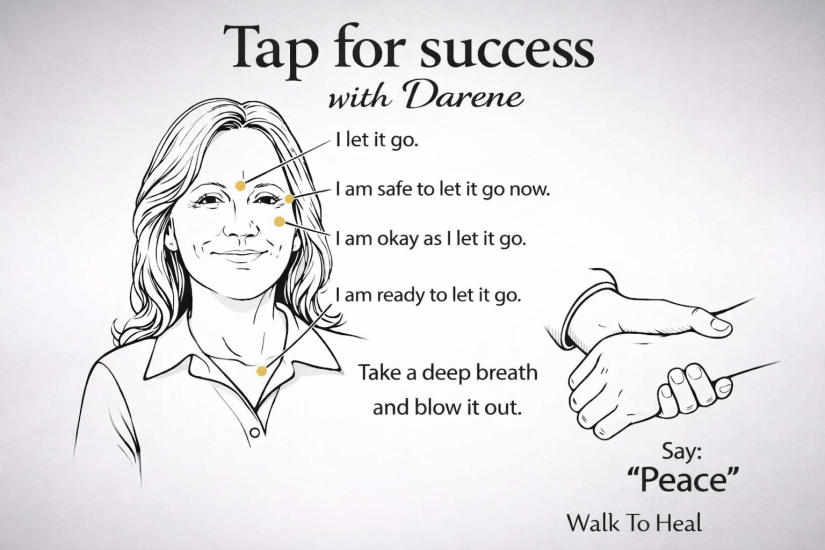
Focus on the discomfort, rate it 0-10 and tap as below on the acupressure points, saying the statements in the diagram and the “clean boundary words”.
Then go to a happy memory in your mind.
Then rate the discomfort again. Keep repeating till it reduces.
Now tap in your new future: “It’s safe to say no to others. It’s safe to say yes to me. I’m ready to put myself first.”
Step 8 — Graduated Exposure
Start small. Choose one low-risk situation this week to say no.
Plan it:
- Who:
- What:
- Exact words you will use:
- Self-regulation strategy beforehand (breathing, grounding, walking):
Afterward, reflect:
- What actually happened?
- Was the feared outcome accurate?
- What did you learn?
Part 5: Integration
Final Reflection
Answer:
- My difficulty saying no is rooted in…
- The core fear driving it is…
- The cost of continuing this pattern is…
- The benefit of changing it is…
- One boundary I will implement immediately is…
Closing Reframe
Saying no does not threaten healthy attachment.
It filters for it.
Boundaries are not walls.
They are instructions for how to remain in relationship without abandoning yourself.
Change begins when you recognize that over-functioning is not generosity — it is survival.
You are no longer required to survive that way.
CONGRATULATIONS, YOU ARE WELL ON YOUR WAY!
Darene
x
If you want to work with me to go deeper, book a session here: https://dareneputtergill.com/want-to-work-with-me/

 Darene Puttergill Holistic Mind-Body Health